Historic War Cemetery in Lesko from the First World War
In the heart of Lesko, right next to the old parish cemetery, lies a unique site – a war cemetery dating back to the First World War. Around 600 soldiers of various nationalities and faiths, who fell in battles in the surrounding area, are buried here.
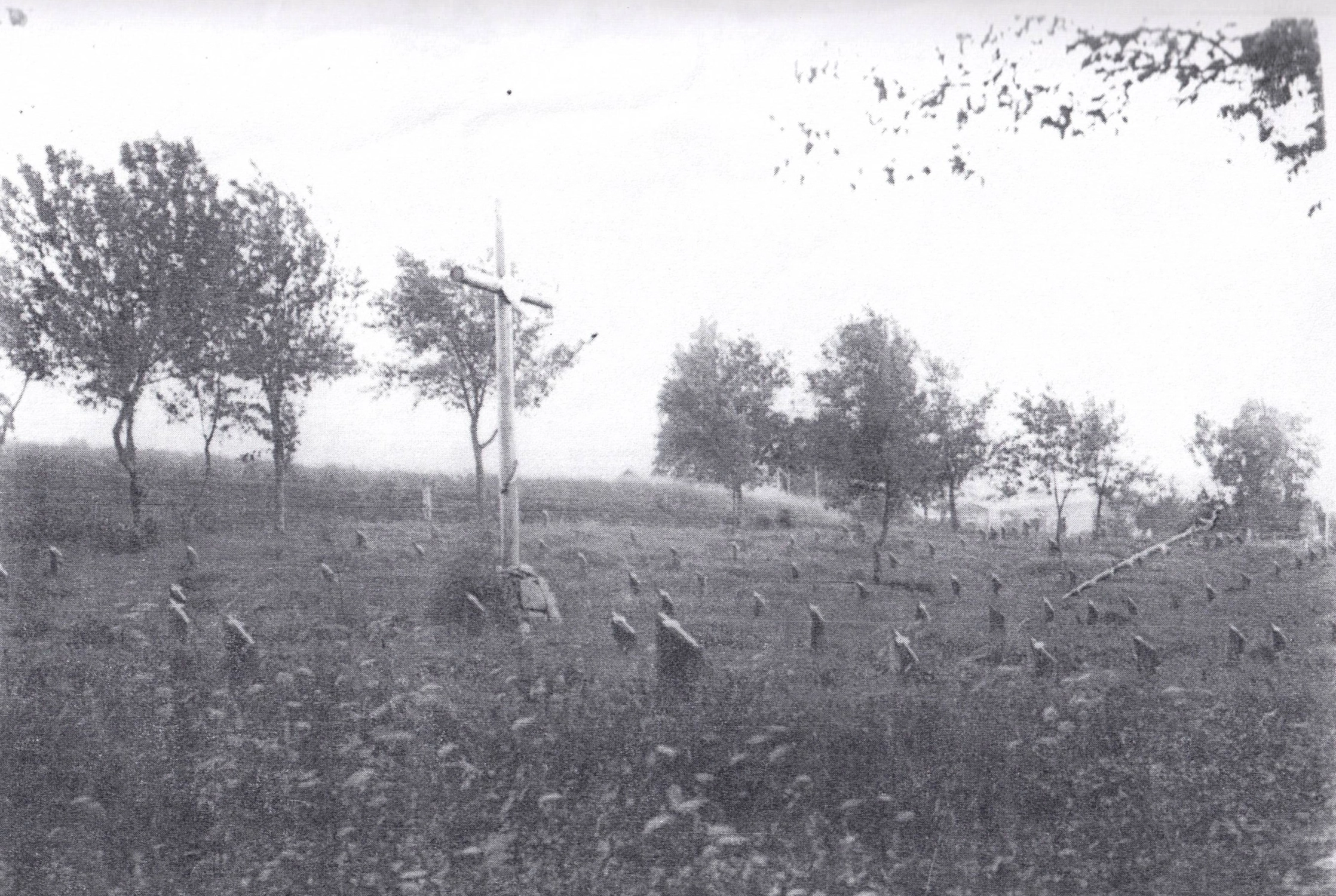
The graves were originally marked with wooden posts, of which only one has survived to this day. The cemetery gate was constructed from wooden beams and planks, and at the top of the gate a Latin inscription was placed: “MORS SOLA VICTRIS — GLORIA VICTIS” (“Since only death is victorious, glory to the vanquished”). A cross made from bayonets, collected from local battlefields, was mounted at the apex of the gate.
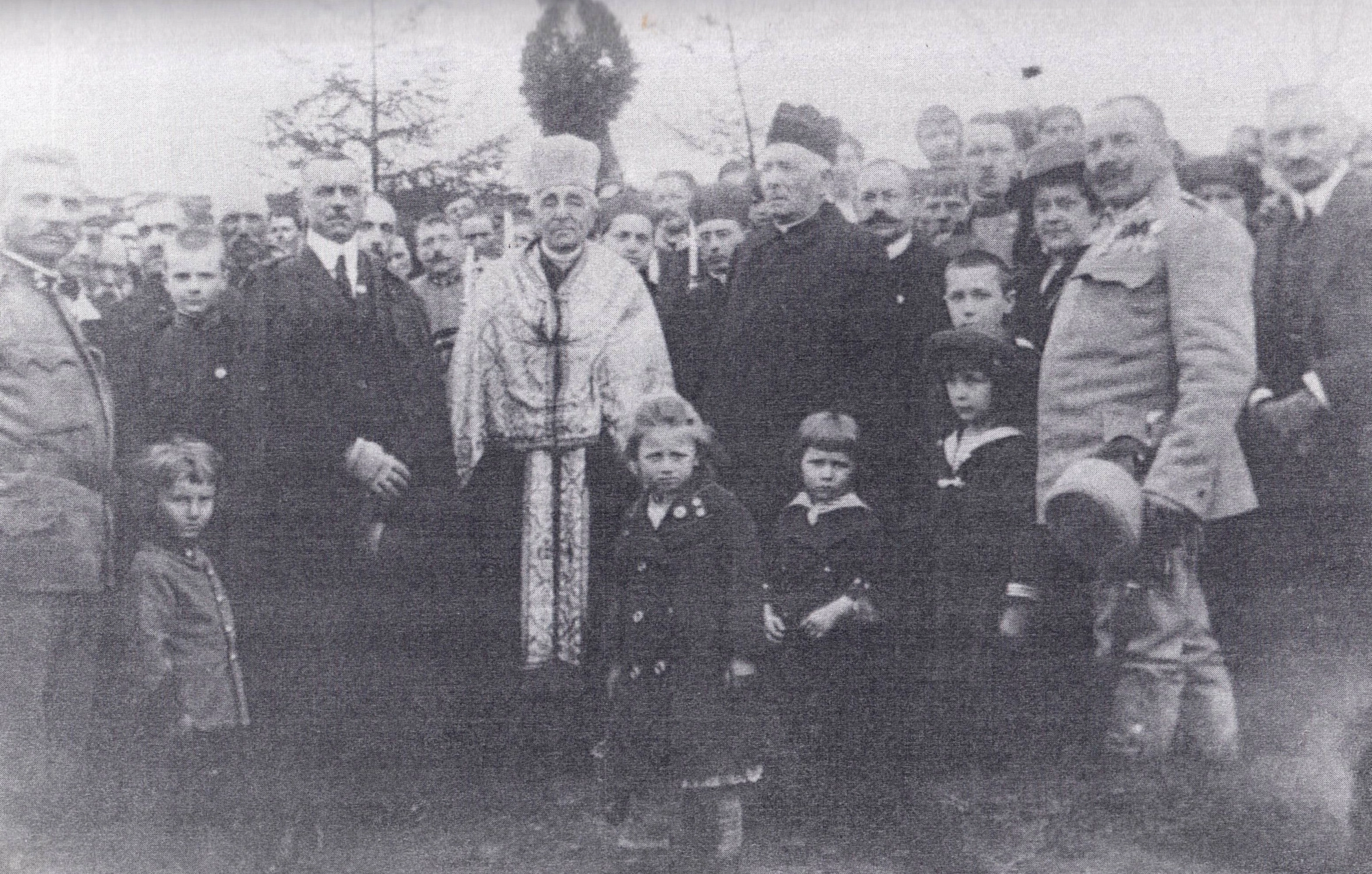
Consecration of the War Cemetery in Lesko – from World War I, 1914–1915, on April 30, 1916 In the photograph: Roman Catholic priest Teofil Dzierzyński, Greek Catholic parish priest Włodzimierz Gmytrasiewicz, district governor K. Pohorecki, and gendarmerie commander Filip Votrub. Photo: Photographer of the Austro-Hungarian Imperial Army.
Consecration Ceremony of the Cemetery
In 1916, a solemn procession took place with the participation of residents of Lesko and nearby villages. Clergy from four different denominations – Catholic, Orthodox, Greek Catholic, and Protestant – jointly consecrated the cemetery and paid tribute to the fallen. Crowds gathered to honor those who had “fallen into the sleep of peace.”
Appearance of the Cemetery in 1916
After World War II, the cemetery fell into neglect. Most of the crosses rotted, the names faded, and the site was overgrown with forest. It wasn’t until the years 1995–2003 that restoration efforts began. Thanks to the dedication of local history enthusiasts, the authorities of Lesko, and international support, both mass and individual graves were restored. Metal crosses were placed where original graves had been located, the earthen mound with a cross and plaque was reconstructed, nameplates were added to the graves, and information boards were installed. The project received support from, among others, the Austrian Black Cross (ÖSK), the Russian Consulate, and the City of Przemyśl.
Lesko / Lisko / War Cemetery from the First World War, 1914–1915 Condition between 1916 and 1939. Photo: Jan Krzywowiąza
Restoration of the War Cemetery
After years of neglect, the war cemetery in Lesko was restored with respect and attention to historical accuracy. Archival research helped reconstruct the original layout of the graves and identify some of those buried. Where possible, the burial sites were confirmed through exhumations.
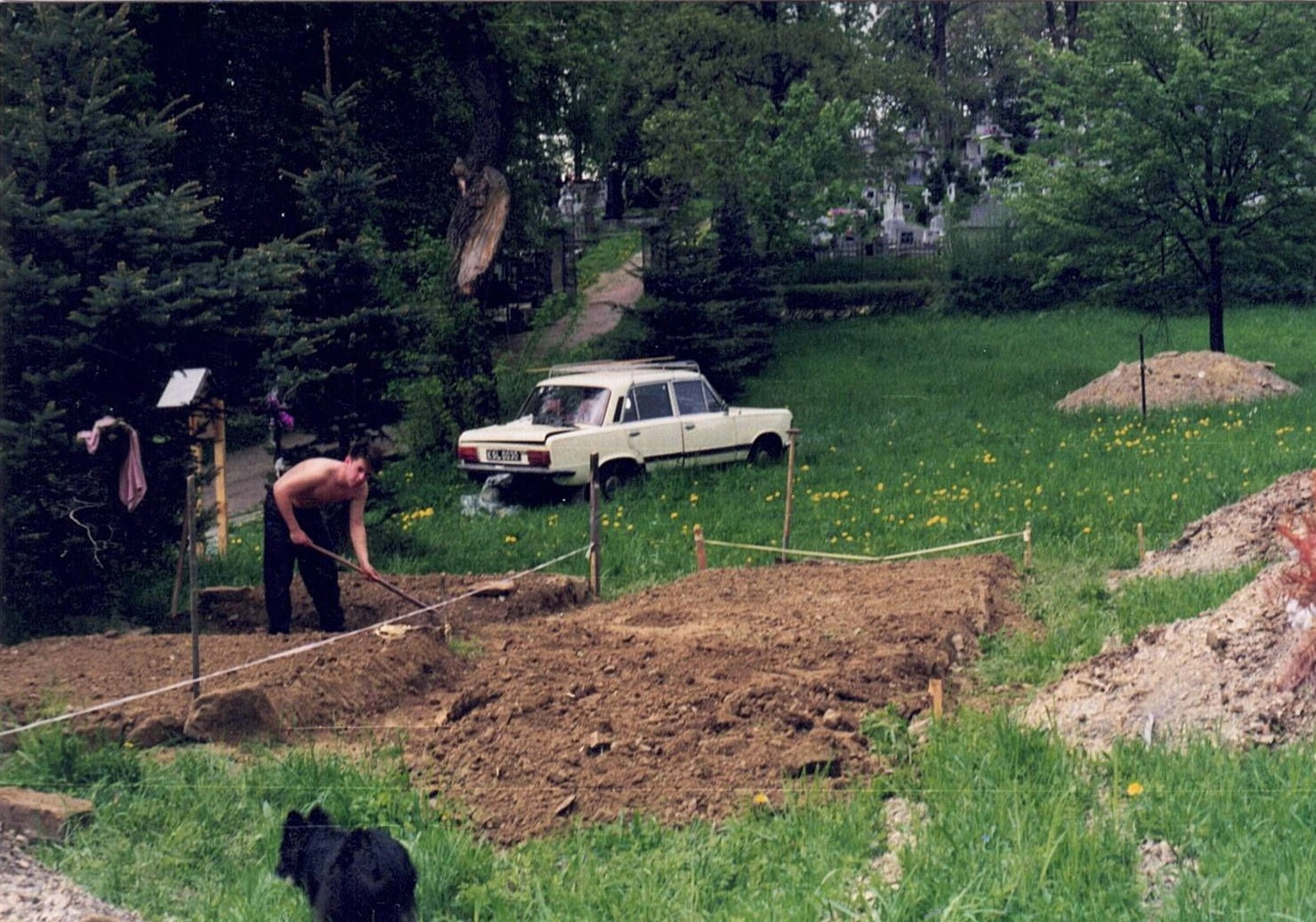
The area was cleared of overgrowth and debris, and the original arrangement of mass and individual graves was reinstated. New metal crosses, modeled on the originals, were installed, and each grave was marked with a nameplate. At the center once again stands the mound with a cross and the Latin inscription – echoing the original design from 1916.
The restoration was made possible through the combined efforts of many individuals and institutions: the Municipality of Lesko, volunteers from Poland and abroad, the Austrian Black Cross, the Russian Consulate in Kraków, and local history enthusiasts. Today, the cemetery has once again become a place of remembrance and reconciliation – a silent testimony to the dramatic fate of the Great War.
Shaping of earthen graves (at the site of former mass graves). In the photograph: Witold Maciela, son of Stanisław. Spring 1996
An International Site of Remembrance
People come here seeking specific burial sites, to light a candle, take a photo, or simply pause for reflection. Some are tracing family history, while others simply want to pay their respects – regardless of the nationality or uniform of those who fought.
Though small in size, this place carries profound symbolic significance. It serves as a reminder of a war that engulfed nearly all of Europe, and of the young men who died far from home.
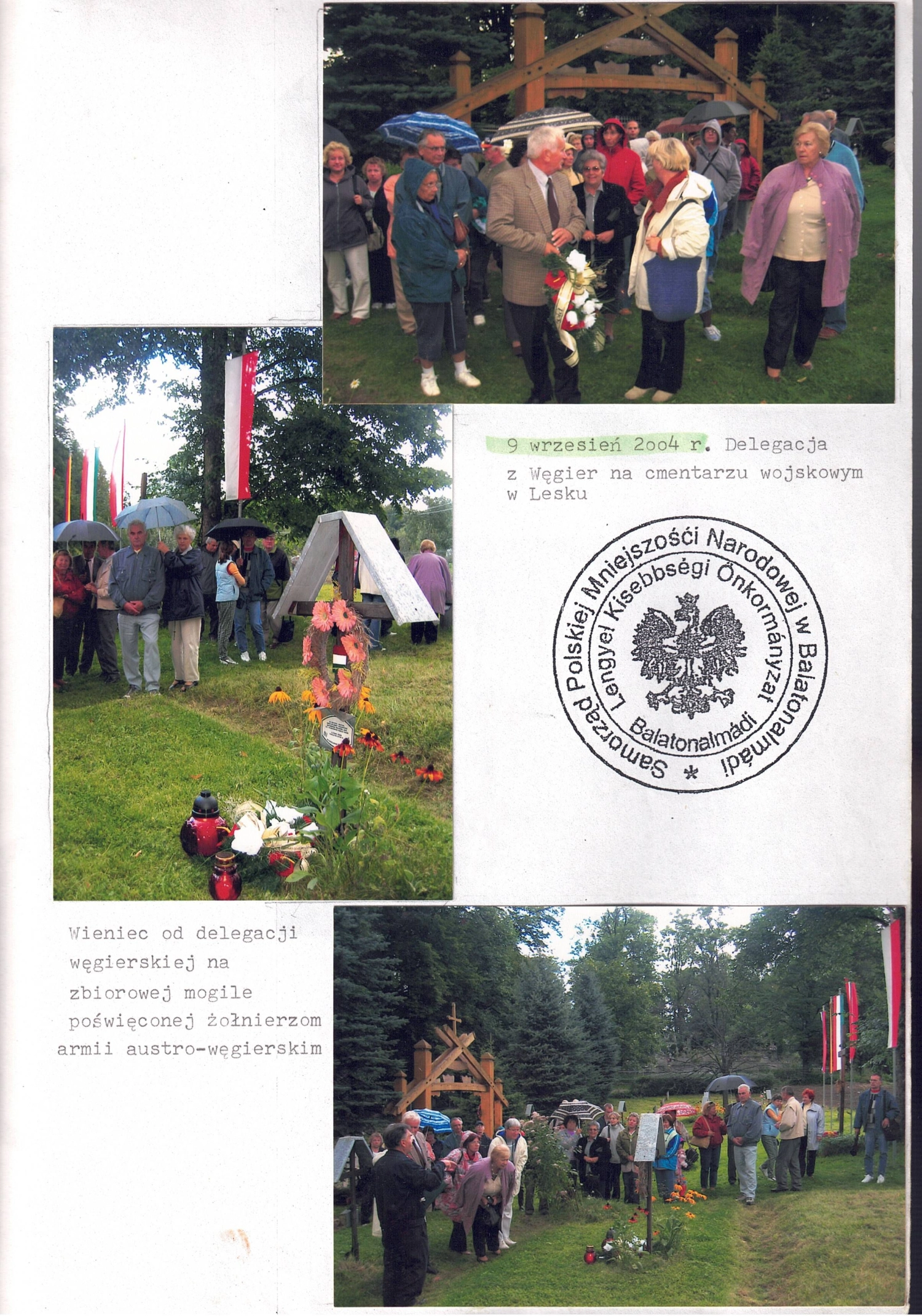
Today, the cemetery is visited by descendants of those buried here, as well as by those interested in the region’s history or in World War I. The presence of people from different countries shows that memory knows no borders – and that even a difficult shared history can unite rather than divide.
September 9, 2004 Hungarian delegation at the military cemetery in Lesko. / A wreath from the Hungarian delegation placed on a mass grave dedicated to soldiers of the Austro-Hungarian army.